The Steve Rotheram question
The Radio Merseyside Hot Seat
I’m currently running the national petition opposing the proposed CCS pipeline connected to the Peak Cluster project.
So when my wife said, “Steve Rotheram’s in the Hot Seat on BBC Radio Merseyside,” I thought — finally. Here is someone elected to represent the people of this region. Someone who must surely have serious concerns about turning the Wirral into a transport corridor for industrial carbon storage.
Thanks for reading Marks-View! Subscribe for free to receive new posts and support my work.
So I emailed in a question, with little expectation it would even be picked up.
To my surprise, Radio Merseyside called back and invited me to ask it live on air. The programme researcher did the usual checks. I declared my involvement in the campaign, my website (www.stopccs.co.uk), and the national petition.Nothing hidden. No ambush. Just a straightforward question from someone who has spent months researching the issue.
You can find the broadcast here — the question is about 2 hours into the playback:
https://www.bbc.co.uk/sounds/play/m002qq9p
The Question
What is the Mayor’s position on the CCS pipeline running through the Wirral?
It’s not complicated.
Yes, it’s direct. But he is paid — circa £95,000 — to answer direct questions. Given the Combined Authority voted in favour of this infrastructure in 2022, it’s entirely fair to ask where he stands.
The Answer
At first there was the usual positioning, but I repeated the question, forcing him to state his position.
The Mayor’s position was conveyed as essentially this: the infrastructure is essential for net zero — so we must accept it (this translated to me as: you just have to suck it up).
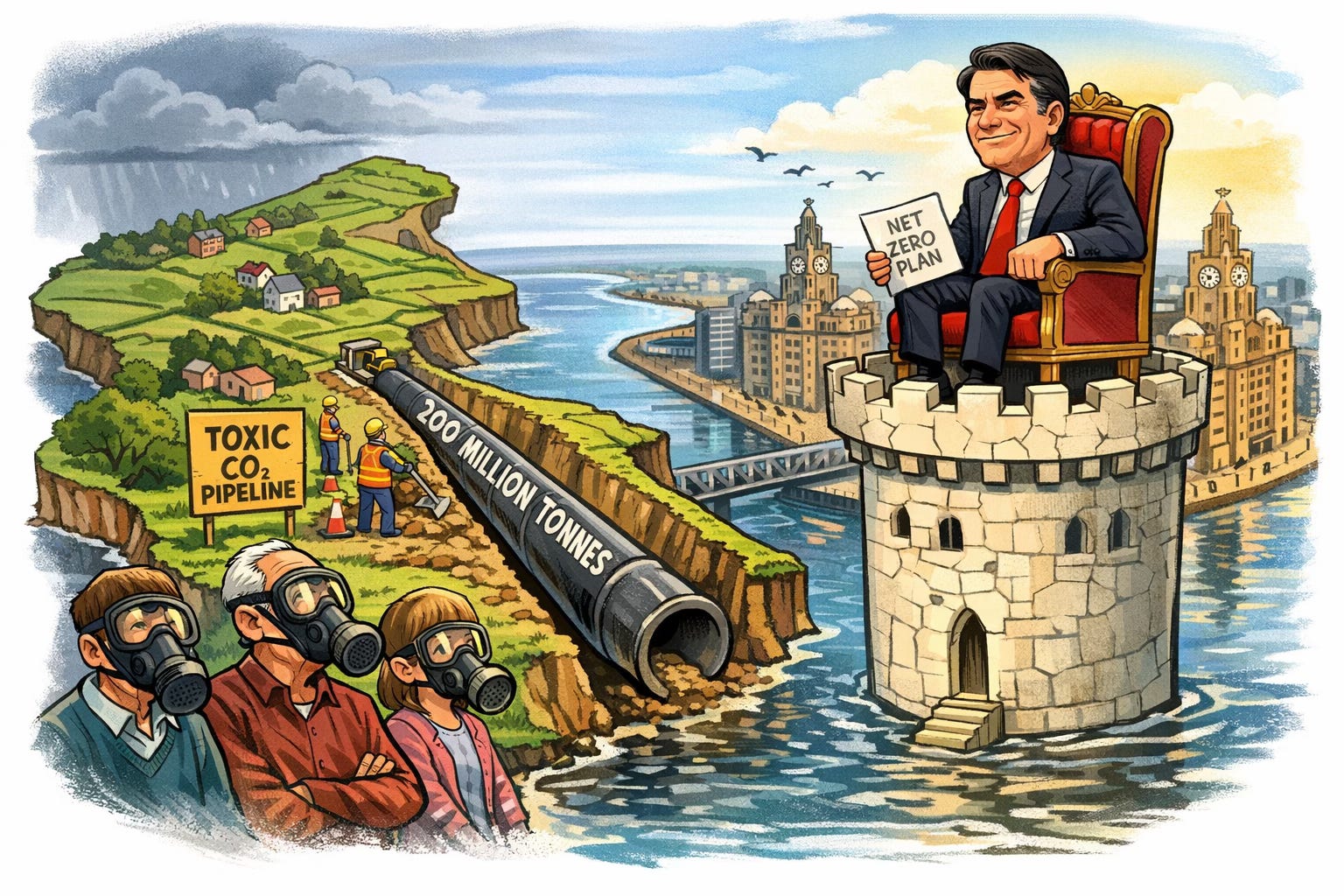
But that’s exactly the problem. Many of us do not accept that 200 million tonnes of concentrated industrial CO₂ should simply be piped through our communities because it supports a national policy target.
He strengthened his position by stating that CO₂ pipelines are not fundamentally different from other pipelines.
A pipe is a pipe. Nothing unusual. Nothing to see here. Except there is.
Running ductile fractures came to mind, but I didn’t want to upset him too much. He was doing fine alienating the people of the Wirral on his own, in my opinion — perhaps not the best argument from a political viewpoint.
The Mayor may not have heard about this risk if he hasn’t read around the subject — maybe he has… but he didn’t call it out. The broader point is that dense-phase CO₂ does not behave identically to natural gas under rupture conditions.
Interestingly, the language was strikingly similar to what I heard at the recent Peak Cluster public briefing — which is available online. Their representatives emphasised that there are over 26,000 miles of pressurised pipelines already operating in the UK.
The message was clear: pipelines are routine. This is nothing unusual.
Yet the critical question is not how many pipelines exist. It is whether this particular type, carrying dense-phase CO₂ at high pressure, presents distinct risks that deserve specific scrutiny.
Except there is.
To be clear, CO₂ isn’t classified as a toxic gas at present; it is generally treated as an asphyxiant. However, if you attempt to breathe 100% CO₂, you will die.
That is not rhetorical flourish — it is basic biology.
…so I think it’s fair to call it toxic. Most people will get it without a court case. I don’t think I’m reframing CO₂ industrial waste gas unreasonably.
The “Exhaust Pipe” Moment
During the exchange, I described the pipeline as effectively acting as the exhaust pipe for industrial waste (thank you Cllr Mark Skillcorn for this excellent expression).
The Mayor took offence at that phrasing and suggested it was emotive.
Of course it’s emotive!!
If 200 million tonnes of industrial toxic CO₂ is to be pumped through your neighbourhood, you’re bound to be passionate. That doesn’t mean it’s an unreasonable statement.
If it is acceptable to say all pipes are the same, we can call it a toxic waste pipe.
Why else would we be pumping it away if we didn’t consider it a problem?
What This Is Really About
This isn’t about theatrics. It’s about risk. Dense-phase CO₂ is not identical to natural gas. In the event of rupture it behaves differently.
- It depressurises differently.
- It disperses differently (CO₂ is heavier than air).
- It propagates fractures differently.
If micro-fractures were to develop, leakage would not necessarily be dramatic. It could be gradual. CO₂ interacting with moisture forms carbonic acid. Acidification of surrounding material is not a fringe idea — it is documented chemistry.
These are not fringe ideas. They are documented engineering realities.
When you are talking about hundreds of millions of tonnes of pressurised industrial CO₂ being transported and permanently stored beneath the seabed, people are entitled to be concerned.
We are justified in questioning whether this is really a good idea: to collect and concentrate toxic materials — don’t you create more of a problem?
2028 Metro Mayor Elections
Mayor Rotherham, just remember: the people of the Wirral won’t forget these choices — it will be difficult to forget. If the whole of the Wirral is being prepared to be dug up for a pipeline no one wants.
When elections come, the public will decide who they believe stood up for them.
—I know who I’m not voting for… any guesses?
Final Thought
When you sit in the Hot Seat, you should expect uncomfortable questions.
Because this isn’t abstract climate theory.
It’s our neighbours. Our home. Our coastline. Our communities.
And 200 million tonnes of pressurised CO₂ does not disappear simply because someone in Whitehall has a PowerPoint that says “net zero.”
My concern — and it is a serious one — is that decisions affecting our community for generations appear to be taken within a process structurally weighted toward delivering net zero targets first, and scrutinising local risk second.
That is not balanced governance. That is policy bias.
Comments
3 responses to “Hot Seat. Hot Air. And 200 Million Tonnes of CO2 Toxic waste”
Cement does not need to have ingredients that are high in CO2, therd ARE alternatives by using geopolymers..we only need to look that this process is being carried out just over the border in North Wales. Material Evolutions in Llay near Wrexham, they are working on producing cement CO2 free. There us NO need for any pipeline it us a money making racket for the construction companies involved
Excellent piece, But we can all bring different aspects to this argument against the CCS project, like the Norwegian project which has cost $billions to date and is constantly hoovering up money due to the fact they have to keep drilling new injection points because the sea bed keeps on fracturing and leaking CO2 into the surrounding environment
Thank you for such a clear and informative posing of the risks and craziness of all this. I’ve just spent the morning delivering leaflets round my area in Meols…you feel you have to do something. I’m organising a dog or no dog walk for next Sunday 22nd Feb starting at leasowe lighthouse 11 am Please spread the word.